
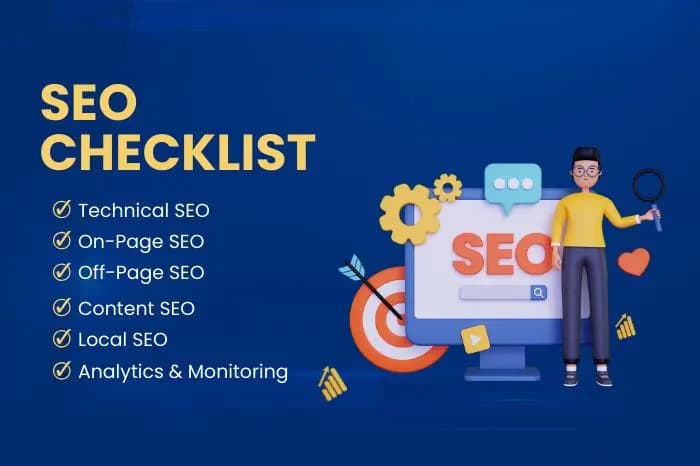
Complete SEO Checklist for New Websites to Rank Faster
It's time to start working on your SEO if you're driven to increase your online visibility. SEO is important for staying ahead as more companies go online. However, to achieve success, businesses must develop effective technical SEO strategies. However, it might be challenging to know where to start due to the different ranking criteria and frequent algorithm adjustments.
Many companies launch a website without considering how users will find it, which results in them missing out on valuable organic traffic from the start. This new site SEO checklist provides an organized framework for creating a solid SEO foundation from the ground up. Make sure your new website is accessible, credible, and prepared to successfully engage your target audience by following these crucial steps.
Go through this checklist carefully, understand it well, and use it on your website so you can start ranking better.
SEO Checklist For New Website
1.Configure Crucial Tracking & Analytics Tools
Search engines provide free platforms called analytics tools that enable you to monitor the performance of your website. Setting up Google Search Console (GSC) and Google Analytics (GA4) is a must for any new website since you can't improve without data. By connecting your website to Google, GSC allows you to see which keywords generate clicks, which pages are indexed, and whether there are technical or crawl issues.
2. Audit your Webpage
You should first do a full audit of your current settings. To find areas for optimization, an SEO audit examines all areas of your website. This can be done internally or through an outside SEO service. Throughout this process, reporting can be quite important because it helps you prioritize areas that require the most focus and gives you visibility into important indicators.
3. Select a CMS That Promotes SEO
Sales on e-commerce websites correlate strongly with speed. Customers want immediate satisfaction when they shop online, particularly when it comes time to check out. Interested parties may completely give up on a purchase if pages are slow during crucial times. Customers can think of your website credibility and your company as unreliable or unprofessional if it is slow at these crucial times, which is something you should absolutely avoid when attempting to seal a deal.
3. Effect on User Experience (UX)
The platform that powers your website and enables you to produce and manage content is called a Content Management System (CMS). Select a content management system that gives you control over SEO parameters such as page names, Meta descriptions, URLs, and alt text for images. Choosing the incorrect CMS makes it more difficult to use tools like GSC, apply structured data, and optimize your content.
4. Learn the Basics of On-Page SEO
Optimizing certain page elements for search engines is known as "on-page SEO." These signals inform search engines about the topic of your material. Ignoring them is a typical error that limits the growth of a new website. These core elements include Title Tag, Meta Description, URL Structure, Header Tags (H1–H3), and Internal Links. By taking the time to optimize these minor details, you can create a solid SEO foundation and improve the readability of your content for both search engines and actual users.
5. Assure Mobile-Friendliness and Technical Health
Technical SEO guarantees that search engines can easily crawl and index your website. Your content is hidden if search engines are unable to visit your website. Examine key components such as crawlability, mobile responsiveness, and page speed. Google supports mobile indexing, so your website needs to load fast and function properly on smartphones.
6. Create a Backlinking Plan
A backlink is a website link that comes from another website. Backlinks are a significant ranking element since search engines view them as votes of trust. Since a new website has no backlinks at first, developing authority requires a proactive approach. Prioritize quality above quantity. A single backlink from a high-authority, relevant website is worth more than hundreds of low-quality ones. The greatest method to get them is to produce excellent content that people are inclined to share and refer to.
7. Boost the essential Web Vitals
Core web vitals are a collection of SEO metrics that assess the visual stability, interactivity, and loading speed of each page. A crucial component of website ranking is achieving a positive score for every indicator. The three fundamental web vital metrics are the Largest Contentful Paint (LCP), the subsequent paint (INP), and Layout shift cumulative (CLS).
8. Find Out LLMs Optimization
AI search is not a single entity. Google's AI Overviews, AI Mode in Search, ChatGPT, Perplexity, Gemini, and other tools may be used by your audience. To see results, you don't have to optimize for each and every one. Make a list of the AI tools that are most likely to be used by your audience.
9. Use LSI Keywords
LSI keywords are words that complement your primary keyword. Terms that you are probably using when discussing your target keyword like writing, website, and content creation. To make optimization easier, use synonyms, LSI keywords, and WordPress SEO plugins like these top choices instead of repeatedly employing the same term.
10. Conduct a Topical Authority Analysis
The measure of your website's authority on a certain subject is called topical authority. It allows you to examine keyword data from Google Search Console to determine what subjects you are already ranking for and to find relevant subjects that you haven't covered. This aids in identifying content gaps and chances to increase your topical authority.
Found this SEO checklist for new website helpful? Share it with others and drop your thoughts in the comment section - I’d love to hear your questions and experiences.
Frequently Asked Questions
Q1. How can SEO benefit from evergreen content?
Content continues to draw regular searches, automatically generates more backlinks, and it helps in maintaining ongoing rankings because content stays relevant for longer.
Q2. How can I identify broken links on my website?
Online link checkers, website audit tools, and SEO platforms are examples of tools that you can use to verify your website for mistakes.
Q3. What SEO-related tasks can ChatGPT handle?
It can produce legible text drafts, blog outlines, keyword clusters, FAQs, schema markup, headlines, and recommendations for internal linking.