
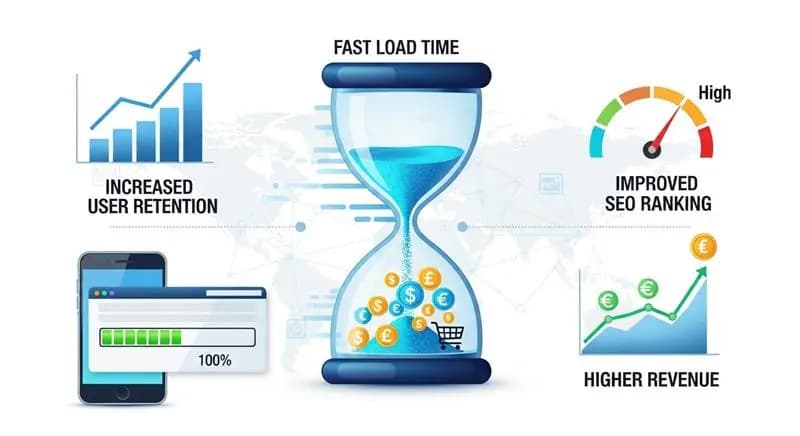
Importance of Improving Load Time & Conversions
In the quick-paced world of the internet, every second matters. If your website takes too much time to load, you will lose clients before they even see what you have to offer, even if you have the most wonderfully designed website, an amazing offer, and a brilliant advertising approach. Speed is a crucial component for business, not only a technical one.
Conversion rates can decline by 7% with a one-second delay in page load time. Your conversion rates are immediately impacted when your website loads slowly. The link is easy to understand: the slower the load time, the lower the conversion rate. This results in wasted opportunities, lost revenue, and a decline in your company's performance.
In this article, we’ll explore the important role of page load speed and how it affects conversion rates, SEO, and user experience.
What is Page Load Time and Why is it Important?
The amount of time needed for a website to display all of its content when a visitor starts navigating is known as the page load time. When a browser submits a request to the server, page load time starts, and it finishes when elements are visible. This significant indicator measures the speed at which a webpage becomes fully responsive and accessible to users.
Server response time is important because it impacts customer satisfaction, company profits, and search engine rankings. Fast-loading websites create a smooth journey that keeps users interested and invites exploration. Consumers still have high expectations for mobile website speed; loading delays irritate users and increase bounce rates.
How Load Time Affects Conversions?
1. More Load Time = Higher Bounce Rate
An increased bounce rate is the first and most obvious effect of a slow website. A "bounce" happens when a visitor quits your website after only viewing one page, typically as a result of being irritated with bad loading times. Users will just click away and visit a competitor's faster website if your website takes too long to load. Additionally, load speed becomes even more crucial as mobile conversion grows and slower connections are more usual.
2. Missed Sales Opportunities
Sales on e-commerce websites correlate strongly with speed. Customers want immediate satisfaction when they shop online, particularly when it comes time to check out. Interested parties may completely give up on a purchase if pages are slow during crucial times. Customers can think of your website credibility and your company as unreliable or unprofessional if it is slow at these crucial times, which is something you should absolutely avoid when attempting to seal a deal.
3. Effect on User Experience (UX)
One of the primary elements influencing conversions is user experience. Users are unlikely to convert if they are frustrated when using your website. Users are more likely to leave your website before performing any planned action when it loads slowly, which affects the overall experience. Your brand's image is enhanced by a smooth, quick-loading experience.
How does website speed affect SEO?
Website speed and conversion are one of the signals Google uses for listing pages. The quicker your website loads, the better it could appear on search engines - and this implies more genuine visitors to your site. Google’s Core Web Vitals update includes page experience signals, which include loading performance monitoring like Largest Contentful Paint (LCP) and First Input Delay (FID). Investing in professional web development services helps improve site speed and conversion rates.
- Amazon discovered that its sales dropped by 1% for every 100 milliseconds (ms) that the page took to load.
- According to Walmart, for every second that the load time was improved, their conversion rate rose by 2%.
- Shopify, an e-commerce platform has demonstrated that faster load speeds result in more sales, and even a one-second delay can damage client confidence.
How to Improve Your Website Speed?
Increasing the speed of your website doesn't have to be difficult. Here are some short, powerful tactics:
- Use caching systems:
Caching enables your website to save copies of commonly used files on the server or in the user's browser. Because the browser doesn't have to download the same resources each time, this speeds up the load time for repeat visitors. Load times can be greatly reduced by implementing caching using programs like Varnish or WP Rocket for WordPress websites.
- Optimize Images and Videos:
Compress photos by making sure they are resized to fit display dimensions, extracting huge image files, and converting them to WebP format. These changes can significantly speed up load times because photos frequently account for a large percentage of a page's weight.
- Cut down on HTTP requests:
Employ CSS sprites, enable browser caching, and minify CSS and JavaScript files to reduce the quantity of HTTP requests. Faster load times result from fewer requests.
- Simplify your Code Optimization:
Make your JavaScript, HTML, and CSS lighter and faster to run. Several web systems offer built-in tools or plugins to manage these optimizations automatically.
- Make Mobile Optimization a priority:
Mobile website performance typically loads 70.9% more slowly than desktop ones. For example, after reducing load times to less than 4 seconds, Zitmaxx Wonen experienced a 50.2% boost in mobile conversions.
If you found this guide helpful, don’t forget to share it with others who want to improve their website performance. Also, drop your thoughts in the comment section.
Frequently Asked Questions
Q1. Why do conversions impact competitive advantage?
In comparison to competitors, higher conversions indicate that you are converting more visitors into clients. Your income and market position both directly rise as a result.
Q2. How can I minimize user abandonment on my website?
Enable caching, optimize pictures, enhance hosting, compress files, cut down on superfluous scripts, and guarantee a seamless user experience on all devices.
Q3. What is the industry standard for mobile load speed?
Because mobile visitors are more sensitive to slower performance, the majority of experts advise that mobile pages load in 3 seconds or less.